
Before Benito
Fania's Greatest Gift was Ourselves

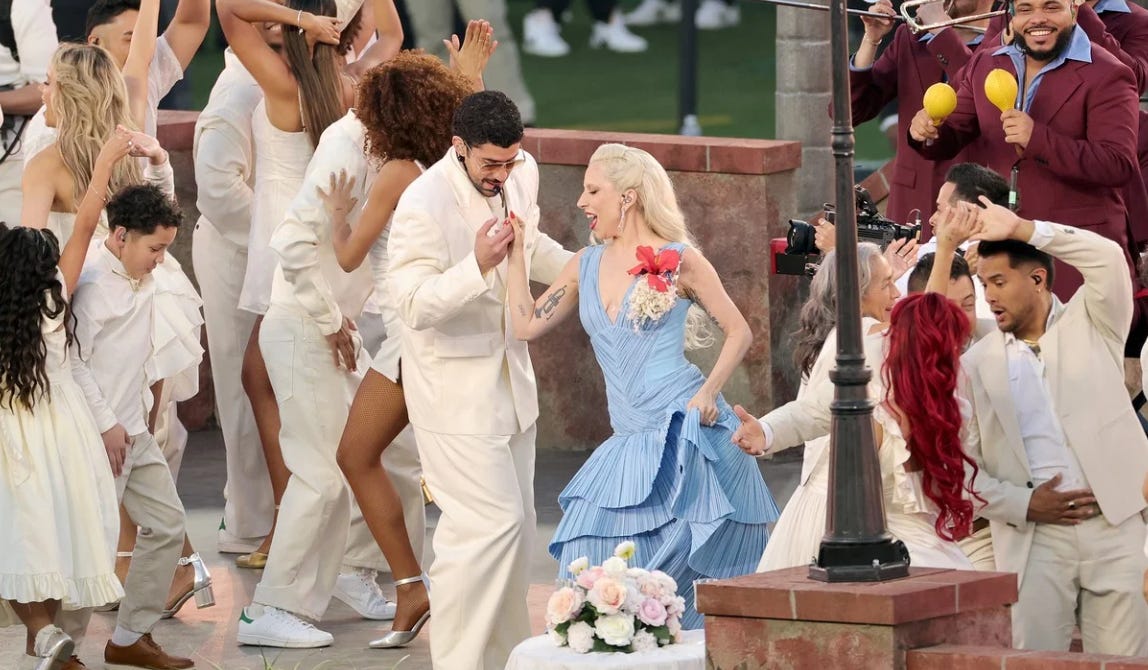
Like millions, I watched Bad Bunny’s Super Bowl halftime performance, and like millions, I really wasn’t super interested in the game. Partially because to call me a casual fan is a gross overstatement (don’t get it twisted, I was dyed in the wool from 1982-2016), and partially because any rooting interest I had was broken along with Bo Nix’s ankle three weeks ago.
What a performance. The jibaros cutting caña, the veteranos jugando dominó, the multiracial profile, the marqueta (read: bodega), and the little kids dancing. Ricky Martin showed up, and I’ll live with Lady Gaga, even though I feel like Olga Tañon or La India would have been better. The nod to Daddy Yankee, and a history of salsa, plena, merengue and reggaetón was excellent. And when he departed shouting the names of all the nations that make up nuestra mayúscula América was reminiscent of Proyecto Uno’s “Latinos” that shouts out all of us, and like at the Broker on Salsa Night in the late 1990s, the crown went wild.
Plenty has been said about Benito Antonio Martínez Ocasio’s music, his person, how he shows up and the seductive defiance that he embodies. He reacts to detractors with love and sensuality, denying hate the resistance upon which it depends to thrive. I’m not going to re-hash everything that has been said by and on behalf of Benito. We live in a country where White supremacists are chomping at the bit to attack us, kill us, destroy us, with impunity. America isn’t divided. “Divided” suggests an equivalency that simply is not factual. White supremacy controls the state. We do not. We are at its mercy.
This performance, though, is a reminder that as a comunidad, we are water. Even salsa music itself challenges the neat and tidy boxes that the White-Black dichotomy has tried to squeeze us into. The instrumentation is both structured and improvised, both colonial and decolonial, both traditional and revolutionary. The way the rhythm section vamps and pulsates, the horns in sharp and audacious unison, and the acentos, las voces singing and chanting, dancing elegantly between technical mastery and gritty reality. Maybe Ricardo Arjona framed it best in his 2000 album Galería Caribe, exploring the lines between conquest and cultural absorption. In “Carabelas” he poses the question:
Carabelas cargadas de malos presagios
Emisarios de la trampa y de la colonización
Tocan tierra provocando un gran naufragio
Cargados de demonios y una nueva religión
Pisaron tierra de Guanahani
Bienvenida la desolación
Esos sueños de estafa y de saqueo
Ese gusto por el oro y esas ansias de poder
Es el cáncer que aún enferma al heredero
Es la historia de una tierra condenada a padecer
Pero el Negro y el Indio y el Español
Se mezclaron para darle un gusto a Dios
Pero el Negro y el Indio y el Español
Se mezclaron para darle un gusto a Dios
Conquest and colonization narratives are true and real, but they suggest a passivity that robs the oppressed of our agency. I saw Richard Rodriguez, noted conservative commentator once declare that “I stole your religion. History is complicated.” and it infuriated me because maybe it was a little bit true. As a raza we struggle to define the 500+ years of our existence in binary terms, because, dawg, that’s hard to do. To negate part of who we are? Can’t do it. Even when we want to.
I want to tell you right here, right now, that Benito is US. And he’s a continuation of my gente’s music and the way we show up in these streets where you assume we are from somewhere else, that we are the antithesis of America, where we actually are the ESSENCE of it.
I get to revel in a musical legacy that spans at least a century, probably more of artists pushing the limits of musical convention. Because before Bad Bunny there was Fania Records. Fania stepped into a vacuum when founded by Johnny Pacheco, bridging the gap between traditional and pop music. When I listen to Bad Bunny, I also hear Joe Cuba, who spoke over slow and deliberate son rhythms, or Ralfi Pagán singing soulfully in English over West Coast Latin melodies. Because we have always been ALL of this. When Mellow Man Ace and Kid Frost offered their voices and sounds to hip hop, when Hector Lavoe and Willie Colón gave us gritty street stories to an upbeat danceable galaxy of rhythm and sonido, they set the stage for Bad Bunny to be in front of thousands of fans, doing what we have always done.
I sit here, lost in my headphones listening to Celia Cruz and Pacheco perform “Quimbara,” wiping tears from my eyes as I listen to “El dia de mi suerte.” I reminisce about my old neighborhood along with Joe Cuba’s “Can You Feel It,” knowing that joy and pain need each other. And seeing NuevaYOL come to life in a space I never thought possible? Healing, y’all.
We have told stories for centuries. And we have more to tell.